One of my most favorite things to do in the world of access control is to work with automatic operator companies to integrate access control systems with automatic operators. In case someone new to access control is reading this article, an automatic operator (AO) is an electro-mechanical device that lives above a door (or doors). When the AO is activated, the doors are automatically opened. Some common brands of AO’s are Assa Abloy, Besam, Horton and more. What’s fun about auto operators and access control is that depending on the intended function, it can take some creativity to devise the most efficient way to accomplish the desired functionality.
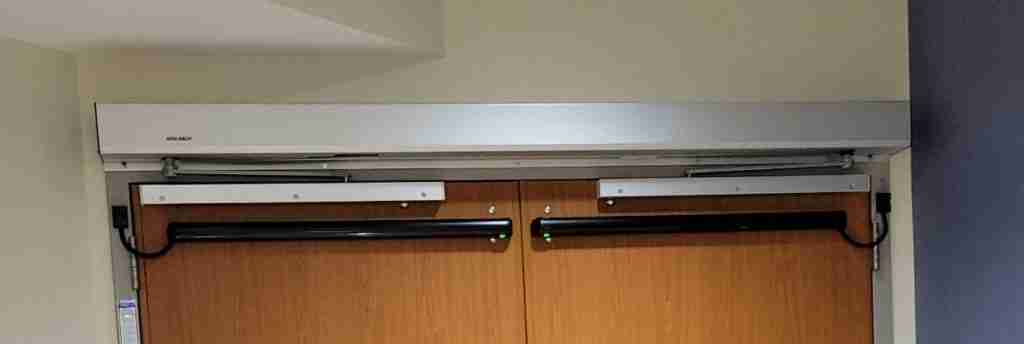
When it comes to wiring devices for doors with AO’s, there are many different approaches that can be taken. There are several variables that need to be considered. If there is a mag lock, sometimes the AO company controls the lock or locks, but other times the access control company controls the lock(s). If the AO company controls the locks, a simple dry trigger from an Altronix RB610 SPDT relay can be used to trip the AO input when a badge is read. When a user wants to exit from the secure side of the door, a wave sensor can be used to trigger the operator. A request to exit (REX) can come from either a motion REX above the wave sensor, or if using a DPDT wave sensor, you can tie the wave into the REX wire going back to the panel.
A request to exit (REX) signifies the presence of a user requesting to exit from the secure side of a door. Without a REX, the system would see a door forced event, as it would appear that no one was at the door trying to exit. Take for example if someone kicked a door in from the outside. The door contacts would be in a closed state, there would be no valid badge read or contact closure coming from a REX relay back to the panel. The system would see this as a door forced open event. The same event would occur even if a door was opened properly from the inside but with no REX device (motion, button etc.)
In todays article, we will be discussing how to wire devices in a scenario where:
- Auto operator company controls nothing but the operator
- Access control devices will include:
- Mag lock
- Card reader
- Wave sensor
- (2) crash bars
- Stanley RPSMLR2 Crash bar power supply (above door)
- Bosch DS160 motion REX
- Door contacts
- Altronix RB610 Relay
We will have (2) trigger sources which, in this setup will both trip the input of the crash bar power supply, which will in turn trip the auto operator from a dry output on the crash bar power supply. I will briefly explain each trigger event flow below.
- Badge is read –> drops lock wire power from panel –> mag lock power and RB610 power drop simultaneously–> RB610 dry triggers crash bar power supply input –> crash bar power supply outputs to crash bars so they retract –> AO output on delay of X seconds (without a delay, AO may activate before the lock(s) de-energize which could cause the door to get hung up).
- Wave sensor –> dry trips crash bar power supply input –> crash bar power supply outputs to crash bars so they retract –> RB610 connected to crash bar PS output energizes and breaks lock power –> AO trip on delay –> REX from either motion REX above wave sensor, or use one of the wave sensor relays to tie into REX wire back to panel
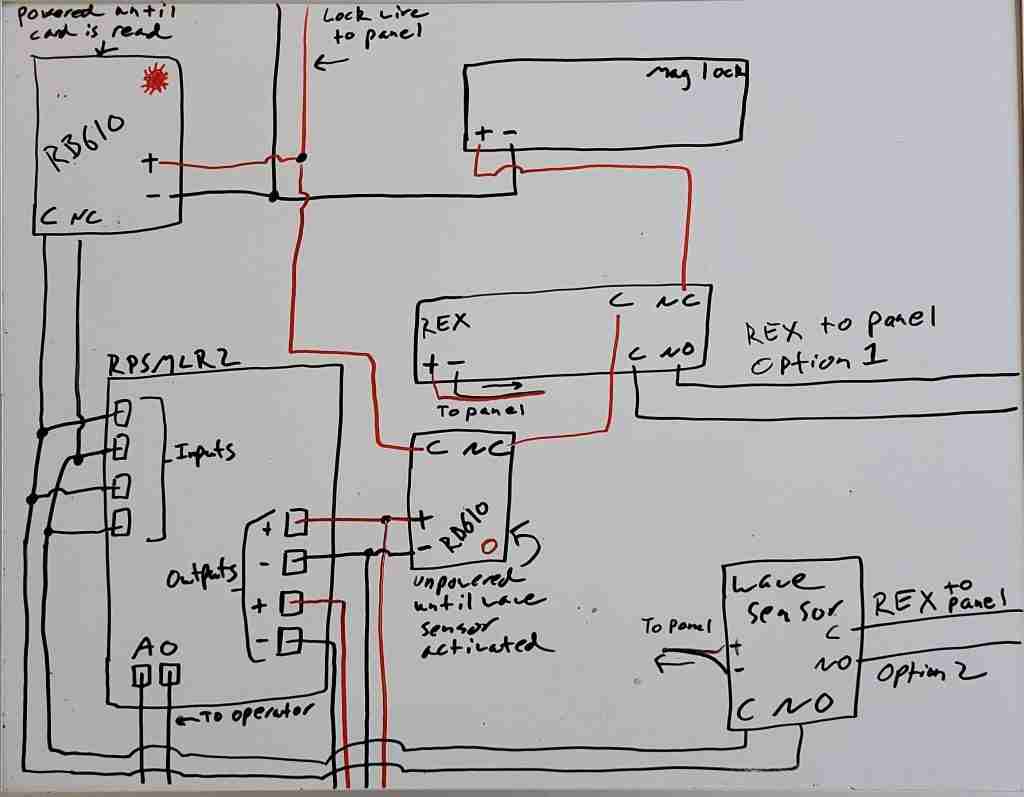
- Below is a crude drawing of how the setup above could be wired. Today, we are using an RPSMLR2 crash bar power supply with delayed AO trip. You will see this crash bar power supply branded by Stanley, BEST by Dormakaba etc.
What needs to happen?
Further elaborating on the two trigger sources noted above, we have “trigger source 1” as a user scanning their badge at a card reader outside of the door. What will happen for this event is when a valid badge is read, the mercury board output relay at the panel will fire, which will then cause a lock power distribution board relay to fire, which will then de-energize the lock wire, causing the RB610 and mag lock to lose power. When the RB610 becomes de-energized, it will dry trigger the crash bar power supply which will then output power to the crash bars so that they retract, followed by a delayed auto operator dry trip for the doors to open.
Remember that the “normal” state of an RB610 is when it is de-energized, so the labels are literal in the “off” state. NC is closed and NO is opened when the relay is de-energized. When energized, the labels are the opposite, so if you need an open when the relay is constantly powered, you would use C and NC. If you need a close when the relay is powered, you would use C and NO. You can always use your meter set to continuity to check your NO / NC states.
“Trigger source 2” will come from a user waving their hand in front of a wave sensor. The sensor will dry trigger the crash bar power supply which energizes and retracts the crash bars and provides an auto operator dry trigger. The only difference this time is that the RB610 that is connected to one of the crash bar outputs will also energize. That is how we accomplish mag lock power disruption from the wave sensor. As seen in the drawing, the mag lock positive leg is sent through the RB610 C / NC. In the off state of the relay, power flows through C to NC. When the crash power supply fires the RB610, the relay state reverses and there is then an “open” between C and NC.
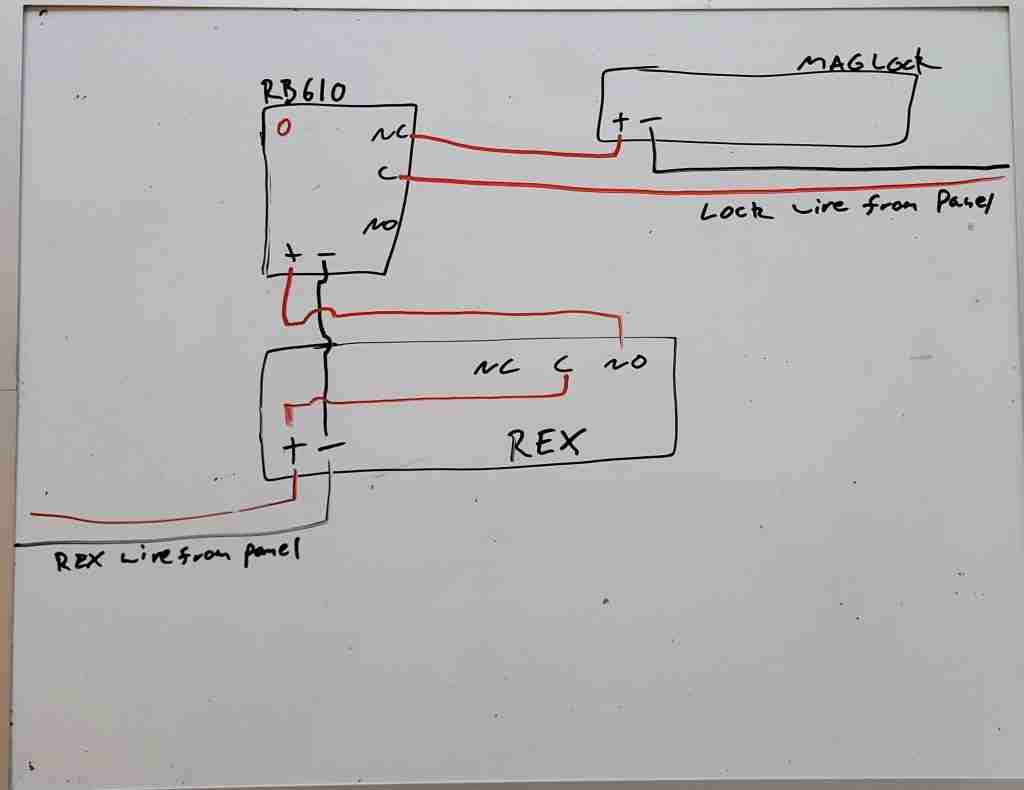
If using a DPDT wave sensor, you could run the hot/positive leg of lock power through one of the wave C / NC relay contacts, and use the other wave relay C / NO to dry trip the operator/ RPSMLR2. This will break lock power while simultaneously triggering the RPSMLR2. Some wave relays like those made by Essex have a 2 amp contact rating, while an RB610 relay has a 10 amp contact rating. Using an RB610 to control making or breaking lock power makes it much less likely for a mag lock that has issues drawing too much current to burn out a device. The same applies to the 1 amp contact rating of the REX relay with lock positive passing through it. The first drawing above shows the mag lock positive passing straight through C / NC, but you can also wire an RB610 into the REX relay for added 10 amp protection. See below.
Integrating automatic operators and access control systems is fun because there are many different devices that come into play. The creativity involved in situations where you just have to make things work with the equipment that you have, while still maintaining safety, proper functionality and efficiency is a fun challenge.